

Rug weaving has been one of the most important and integral parts of Afghan heritage for centuries. Having always maintained its popularity in the Afghan world, carpet weaving remains highly valued today. With their intricate weaves and unique details, Afghan rugs are highly sought after in many parts of the world. Afghan rugs, which subtly reflect ethnic diversity, enjoy a great reputation worldwide. Afghan rugs stand out for their predominant use of dark colors, tight weaves, and dense patterns. Generally sturdy, durable, and highly attractive, Afghan rugs reflect the legacy of carpet weaving passed down through generations.
History of Afghan Rugs
Afghan rugs convey their historical essence in every detail. Handcrafted with great care, these rugs have a deep-rooted history. The history behind Afghan rugs reflects the deep scars left by war. Between 1979 and 1992, at least one million Afghans fled Afghanistan due to the war with the Soviet Union and the civil war that followed immediately afterward. The vast majority settled in Pakistan and Iran.
The Afghan rug style emerged in the early 1980s. Quite distinct from the Iranian rug style, the Afghan rug style is also known as the “Afghan war rug” due to the wars. Afghan rugs are distinguished from others by their depiction of iconic images of war. As the name suggests, Afghan rugs were first produced in Afghanistan. Today, however, these rugs are produced by Afghan refugees living in Pakistan and Iran.
Characteristics of Afghan Rugs
The characteristics of Afghan rugs set this type apart from other styles. Afghan rugs have distinct differences compared to other rugs. The most important characteristics of Afghan rugs are as follows:
- Afghan rugs are hand-woven and are unique, artisanal products.
- Afghan rugs feature traditional motifs and war-related designs.
- They are known for their extensive use of vivid and deep colors.
- These rugs are produced by Afghan refugees living in Pakistan and Iran.
- They complement classic, modern, and retro home styles.
- Pattern density is a key feature of Afghan rugs.
- Afghan rugs are dyed using natural dyes.
- Burgundy and shades of red are the predominant colors in Afghan rugs.
With their rich mix of colors and vibrant patterns, Afghan rugs reflect the impact of years of political turmoil and the severe damage caused by attacks.
Afghan Rug Colors and Patterns
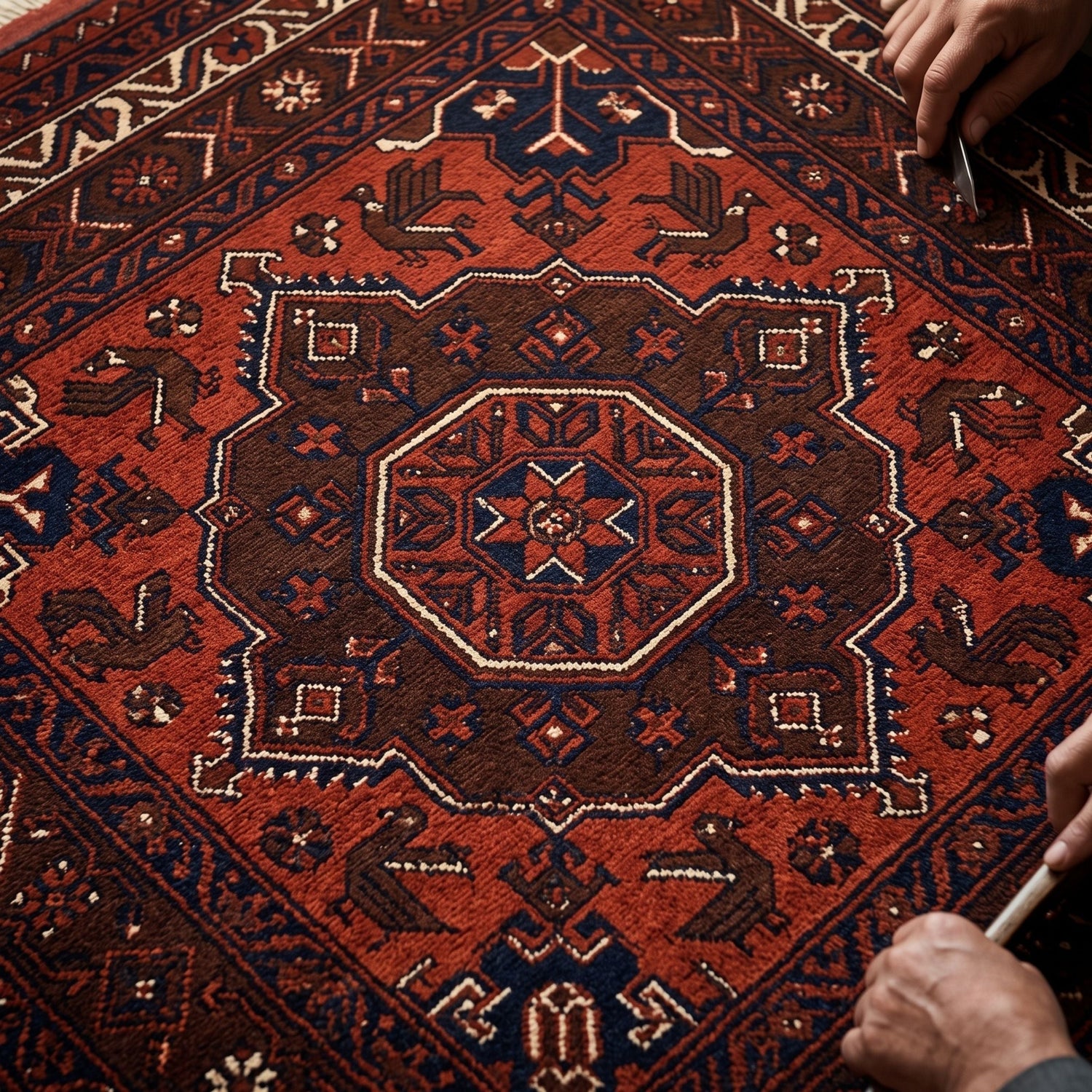
Sturdy, extremely durable, and attractive, Afghan rugs derive these qualities from their unique colors and patterns. Each color and pattern reflects the deep-rooted history of Afghanistan. The vast majority of Afghan rugs have retained their original form. In other words, weavers typically produce rugs with patterns and colors similar to those they have been weaving for decades. In Afghan rugs with a war theme, in particular, certain patterns clearly related to war can be seen. Instead of basic geometric shapes, these rugs may feature iconic images of war.
In an Afghan rug with a war theme, helicopters, heavy weapons, artillery, and tanks are intricately woven. Rugs featuring Soviet tanks and missiles stand out for their captivating and vibrant appearance. With their war themes, Afghan rugs offer both an artistic and intriguing perspective on a culture shaped by war in the modern era. Today, Afghan rugs—which rank among the finest rugs produced worldwide—are crafted primarily in shades of red and burgundy. Blue, yellow, green, and orange are also frequently used colors in these rugs.
What Are the Different Types of Afghan Rugs?
There are many varieties of Afghan rugs. These varieties are generally determined by the quality of the yarn. Afghan rugs, woven from wool by hand, are finished with silk and cotton fringes, giving the rug its final form. In addition to these models, which add color to a space with their highly dynamic appearance, there are also models such as the Afghan Uşak carpet and the Afghan Kunduz carpet. While the Afghan Kunduz rug, made with Kirman yarn, is extremely durable, the Afghan Uşak rug is woven from wool and stands out for being dyed with natural dyes.
In addition to these most popular Afghan rug models, there are many other varieties available. With each option, the rugs adapt perfectly to different settings. Afghan rug models can be used in many areas, such as living rooms, lounges, kitchens, and bedrooms. Offering a significant advantage due to their durability, Afghan rugs are also preferred in offices and workplaces. For those who particularly enjoy ethnic styles, Afghan rugs rank among the best options.
How Are Afghan Rugs Made?
Extremely durable and sturdy, Afghan rugs are woven on small, portable looms. The vast majority of Afghan weavers still adhere to the fundamental principles of weaving. When they were first designed, Afghan rugs were produced by weavers to decorate the tents where they lived. Made with Iranian knots, Afghan rugs are woven by hand using plant-dyed Afghan wool. In some rugs, pre-dyed wool yarns are combined with natural dyes.
The fact that Afghan weavers remain faithful to the rugs’ original form ensures that Afghan rugs serve as a vital carrier of culture. These rugs come in various types, such as felted wool rugs, hairless plain-woven rugs, and looped and knotted rugs made of wool. Accordingly, they come in varying qualities. A large Afghan rug is completed after 6 to 9 months of meticulous weaving. Today, Afghan rugs are produced using various techniques, including both hand-woven and machine-woven methods.
How Can You Tell if an Afghan Rug Is Authentic?
Afghan rugs are typically made from Ghazni wool, Merino wool, Welayaty wool, and Belgian wool. While other types of wool are used in some handmade Afghan rugs, these four varieties are the most commonly preferred. Each type of wool contributes distinct characteristics to the rug’s softness. A soft, silky sheen and high durability are among the most important features of authentic Afghan rugs. In addition, you can distinguish an authentic Afghan rug by the following characteristics:
- It does not have a thin, textureless structure. Instead, it has a much thicker, plush, and soft texture.
- Their backs are usually made of cotton, and their surfaces are soft.
- The colors do not fade and mostly retain their original appearance.
In addition to all this, an authentic Afghan rug can be distinguished by its material quality, characteristics, and weaving technique.
Afghan Rug Care
There are many details to keep in mind when it comes to the cleaning and care of Afghan rugs. Since Afghan rugs can be used in all rooms—such as bedrooms, living rooms, and kitchens—and are also a popular choice for offices, it’s important to pay attention to the rug’s material quality and patterns during cleaning. For example, Afghan rugs made with natural dyes do not suffer from issues such as color fading. Consequently, these products can be easily washed. Additionally, different rug washing and care methods must be used depending on the type of yarn used.
To preserve the appearance of Afghan rugs, it is important to vacuum them regularly. Cleaning with cloths dampened with lukewarm water—without the use of chemicals—helps maintain the rugs’ quality. If you have sufficient space relative to the rug’s size, you can perform a thorough cleaning. For a safer and more effective cleaning method, professional carpet cleaners are recommended.

Leave a comment
This site is protected by hCaptcha and the hCaptcha Privacy Policy and Terms of Service apply.