

The art of carpet weaving—whose foundations were laid by the Turks and later began to be practiced in many regions of the world—is a reflection of and an integral part of Turkish culture. The Pazırık Rug, the world’s oldest known carpet, was also found in a Turkish burial mound and was woven using the Turkish knot. Today, carpet-weaving workshops can still be found in various regions and cities across Turkey, from east to west and north to south. While some of these rugs are produced for local use, others are exported to Western countries where there is an interest in Eastern motifs. In addition to being a necessity, loom-woven and machine-made rugs also serve as accessories for living spaces with their stylish designs.
What Materials Are Needed to Weave a Rug?
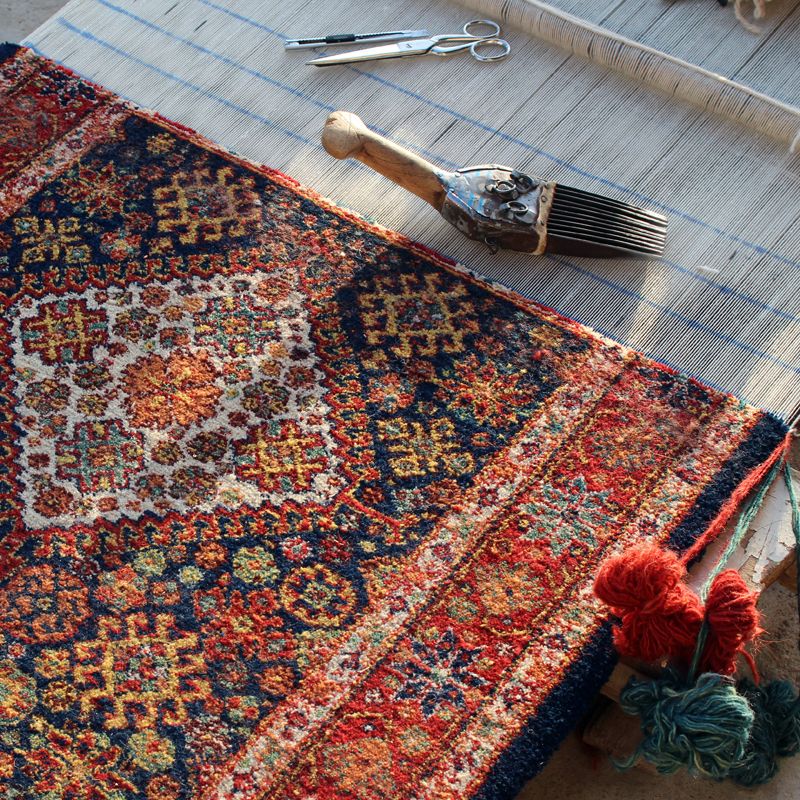
Rugs, an indispensable part of homes for both decoration and providing a warm floor, are woven by compressing threads—which form connections around the warp—using a tool called a kirkit. Handwoven rugs require a loom and wool yarn. Tightly stretched wool threads are tied to this loom—which is formed by interlacing large rods—from top to bottom. These taut threads, known as the warp, form the rug’s framework. A stick called a “varagele” is placed parallel between the warp threads, leaving a gap to facilitate the knotting process. The thread passed through the warp threads during the weaving process is called the weft. Once the weft yarn has been passed through and a row of knots is complete, the row is pushed down and compacted using a compressing comb called a “kirkit.” This is how the rug is woven. The motifs woven into the fabric transform this process into an art form. Each region reflects its culture and spirit through its unique motifs.
Where Is Rug and Kilim Weaving Common in Turkey?
While Uşak, Bergama, Hereke, Ladik, Milas, Konya, Sivas, and Isparta are particularly well-known, carpet weaving is practiced in many cities across Turkey. Starting in the 17th and 18th centuries, Kırşehir, Mucur, Kula, Ladik, and Milas emerged as renowned carpet centers. By the mid-19th century, a rug-weaving factory was opened in Hereke, marking the beginning of the production of Ottoman palace rugs. This factory continued production during the Republican era after becoming part of Sümerbank. Rug weaving branches were also opened in Isparta, Diyarbakır, and Bünyan under Sümerbank to produce rugs for export. Isparta, Bünyan, and Sivas focused more on commercial workshop carpet production featuring Western-style patterns. Meanwhile, rugs from Gödes, Kula, Bergama, Ayvacık, Ladik, Niğde, Döşemealtı, and Milas are distinguished by their local styles. Rugs woven by local people to meet their own needs are found in Denizli-Çal, Kars, Ağrı, Erzurum, Şanlıurfa, Gaziantep, Sivas-Şarkışla, Beyşehir, Adıyaman-Pişinik, Kahta, and Besni. With the exception of the Black Sea region, carpet production continues in nearly all of Turkey’s provinces through either local or commercial weaving.
machine-woven rug Production
Rug production, keeping pace with new-generation technologies, is also carried out using machines. Unlike hand-woven rugs, machine-woven rugs use filler yarns such as jute, linen, and cotton to ensure a flatter appearance. Additionally, the loops consist of yarn segments compressed into U and V shapes between the weft yarns rather than being knotted. machine-woven rugs, which continue to be produced using modern technology, are designed to align with contemporary trends. machine-woven rugs are categorized based on their fabric structure and loop shapes; the most common type is the Wilton carpet. In Wilton-style rugs, which are woven with knife-edged wires, both cut-pile and looped-pile rugs are produced. In machine-woven rug production, machines mimic the weaving methods of hand-woven rugs to achieve the same texture in a shorter time and at a lower cost.
If you’d like more detailed information about the production of hand-woven silk rugs, you can read our article titled “Silk Rug Weaving.”

Leave a comment
This site is protected by hCaptcha and the hCaptcha Privacy Policy and Terms of Service apply.